
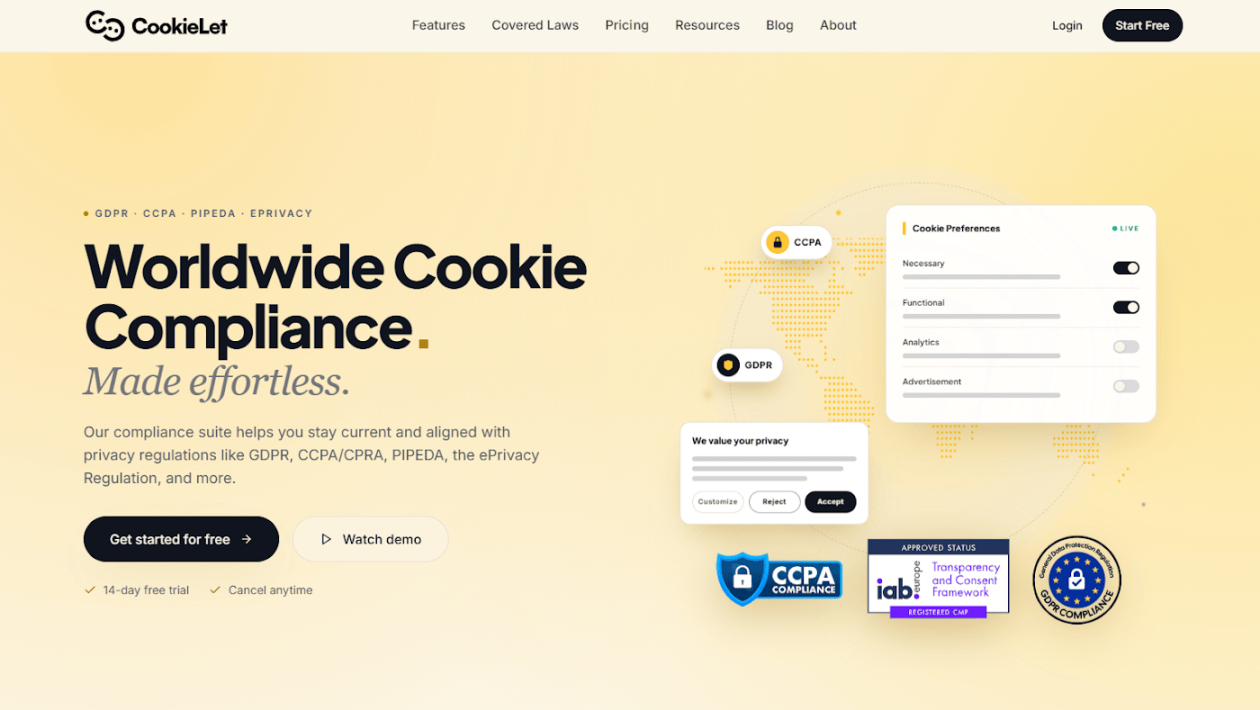
If you use cookies, analytics, advertising pixels, and tracking scripts on your site, manually managing the consent process might become complicated. A cookie consent management tool will take care of automating your consent, blocking, logging, and compliance.
You have probably seen the cookie popup with options like ‘Accept All,’ ‘Reject All,’ or ‘Manage Preferences.’
However, that is just one visible element of cookie consent management.
What goes on behind that scene is identifying cookies and trackers, organizing them into categories, controlling non-essential scripts, logging the user choice, and ensuring the entire process is privacy-compliant.
And that is where the cookie consent management tool comes in handy.
What Is a Cookie Consent Management Platform?
What's in this article...
A cookie consent management platform or a CMP is a software designed to manage and collect cookie consents on your site.
Instead of managing cookie banners, scripts, consents, cookie list separately, a CMP allows you to unify all these functions.
Some useful features of an efficient platform include:
- Cookie scanner on your website
- Classification of cookies according to their function
- Showing a personalized cookie banner
- Enabling people to either grant or reject cookie consent and customize preference
- Blocking unnecessary script until cookie consent is required
- Consent data storage
- Analysis of consents
- Different compliance standards of various regions
- The aim is not to show a cookie banner.
- The aim is to ease and unify the whole process of cookie management.
Why Do Websites Need Cookie Consent Management?
Website changes are continuous.
Today you can include Google Analytics, tomorrow a marketing pixel, and the day after that another third-party extension. Each of these may create their own cookies or other forms of tracking technologies.
Herein lies the complexity of manually managing cookies.
A cookie consent management platform makes it possible for you to track what is being done on your website and correlate this information with your consent processes.
This is particularly helpful when your website caters to visitors from multiple jurisdictions who have varying levels of privacy protection.
Take note: having a cookie banner does not necessarily mean that your website is compliant.
How Does Cookie Consent Management Work?
A cookie consent flow usually involves a number of elements.
- Scan the website
The platform scans your website to find cookies, pixels, scripts, and other tracking technologies.
CookieLet’s Cookie Scanner tool helps recognize and categorize these technologies so that you could see what technologies are used on your website.
This step is necessary as your current cookie usage may differ from the list you compiled a couple of months ago.
- Categorize cookies
Cookies can be categorized depending on their purposes, such as necessary, analytics, functional, or marketing.
It will help visitors better understand what they give their consent for.
- Show the consent banner
When visiting the website, a visitor sees the consent banner.
With CookieLet you have a consent banner editor that allows you to customize elements such as layout, colors, fonts, buttons, content, and languages.
Therefore, your consent banner can blend into your website seamlessly.
4. Manage Non-essential Tracking
This is one of the most crucial steps.
The consent banner must not only seek consent while non-essential tracking scripts keep executing in the background.
CookieLet’s auto-blocking feature stops non-essential scripts and embeds from executing until consent is obtained.
- Document Consent
As soon as the visitor decides something, this decision can be documented.
CookieLet’s Consent Log logs the consent activities, along with other information like timestamps, country, website, version of the banner used, and version of the policy used.
Key Features to Look for in a Cookie Consent Platform
Not all cookie consent tools provide the same degree of control.
In your comparison of cookie consent platforms, don’t only pay attention to the banner design.
Automatic Cookie Scanning
Website changes require changes in your cookie portfolio.
CookieLet’s scanner will help you find all the cookies, pixels, and third-party scripts that are present.
Customizable Cookie Banners
Your cookie banner needs to be user-friendly and comprehensible.
With CookieLet, you have an option to modify the banner’s look and content: layout, font, color, button, position, and language.
Automatic Script Blocking
A cookie management platform needs to help enforce visitors’ decisions.
CookieLet can automatically block all non-essential scripts until consent is given. Thus, linking the consent banner with actual activity on the website.
Consent Logs
Having a record of consent can be useful in case you need to prove when and how the decision was made by the visitor.
With CookieLet’s Consent Log, you have searchable and exportable information about visitor’s decisions.
Consent Analytics
Consent analytics allow tracking how users engage with your consent process.
CookieLet has a variety of analytics which can help you see what consent engagement is like based on criteria like countries, devices, and banner layers.
This insight will also be helpful in finding consent processes that are unclear and inefficient.
Geo-Targeting
Different regions may have various privacy needs.
CookieLet will assist you in building geographically relevant consent and compliance procedures and multiple policies for different audiences.
Cookie and Privacy Policy Tools
Consent from users regarding your cookies does not happen as an isolated event.
You also need to provide visitors with information about what kind of cookies you use and how the user’s data is managed.
CookieLet has tools that can create documents regarding cookies and privacy policy.
Cookie Banner vs. Cookie Consent Management Platform
Cookies banner and CMP are two different concepts.
The cookies banner is what users will see.
Cookie consent management platform runs an overall process behind it.
Imagine that the banner is your entrance door. Your CMP works behind that door as a system.
The banner can capture one click, while the CMP can analyze your website, classify tracking pixels, block scripts, save consents, generate analytics, and offer different consent collection methods.
This is why focusing on the look of the banner when choosing a CMP can become a wrong approach.
Choosing the Best Cookie Consent Platform
When selecting a CMP, you should make sure that:
It will scan my website
You will need a system to recognize any new or existing cookies and tracking.
It will block non-essential tracking pixels?
The consent collection should correspond to the actions of your scripts on the page.
Is it possible to customize the banner?
There should be options to adjust the design, text of the banner, supported languages, and consent categories.
Can it store consent history?
It should be easy for you to track and understand the consent flow.
It supports target regions
Privacy policies of your targeted areas should be considered.
Can my team manage it easily?
If every small change requires a developer, keeping your consent setup current becomes harder.
Common Cookie Consent Mistakes
One common pitfall is seeing the cookie banner as the whole answer.
Another issue is overlooking new forms of tracking. One new plug-in, marketing tag, or other third-party tool can dramatically alter your cookie environment.
It’s worth being careful when it comes to designing the cookie banner for manipulation. Making the Accept button clearly visible but the Reject button harder to see will get people to agree to more cookie use.
Lastly, if there’s already a Cookie Management Platform installed on the website, be sure to either remove it or deactivate it. Having two consent systems at the same time can be problematic.
Is a Cookie Consent Management Platform Worth It?
It definitely will be for many websites out there.
If you have something like analytics installed on your site, advertisements, pixels, any third party content and anything else that might require some kind of consent management, things could get pretty hard.
CMP would allow you to control cookies and consent and scripts and logs and understand how your visitors interacted.
The key point here is to find a system that suits your specific website.
A Simple Way to Start
Start with your website.
Perform a scan to discover which cookies, scripts, and trackers are actually there on your site and assess how effective your existing consent banner is at managing those technologies.
Then patch up any holes.
CookieLet is an all-in-one solution for cookie scanning, configurable consent banners, auto-blocking, consent logging, consent analytics, policies management, and even geo-consent management.
Don’t overcomplicate the whole process.
First understand what technologies are there, and then build proper consent management around them.
Frequently Asked Questions
What is a cookie consent management platform?
This is software that enables websites to manage the consent of their visitors in relation to cookies and other tracking technologies. It includes cookie scanning, consent banners, script blocking, consent storage, analytics, and regional consent management.
Is a cookie consent management platform the same as a cookie banner?
No. The cookie banner is the interface that the visitors see. A cookie consent management platform handles the entire consent process, including scanning, blocking, consent storage, and reporting.
Does CookieLet scan websites for cookies?
Yes. CookieLet’s Cookie Scanner enables you to identify the cookies, pixels, third-party scripts, and other tracking technologies on your websites.
Does CookieLet block cookies without consent?
CookieLet can block non-essential scripts and embeds automatically until the necessary consent is received.
Can I customize a CookieLet consent banner?
Yes. CookieLet allows you to customize aspects including banner appearance, colors, fonts, buttons, text, placement, and languages.
Is a cookie consent platform enough to be GDPR compliant?
No cookie consent management platform (CMP) can guarantee compliance alone. A CMP can assist with implementing and managing certain aspects of consent, but companies must configure the system properly and comply with relevant regulations in their data practices and policies.
What features should I look for in a cookie consent platform?
Cookie scanning, automatic blocking, customizable banners, consent records, analytics, regional support, policy generation capabilities, and easy administration are some of the features to look for. However, the most important thing is that the cookie consent platform suits your website and privacy laws of your audience.